
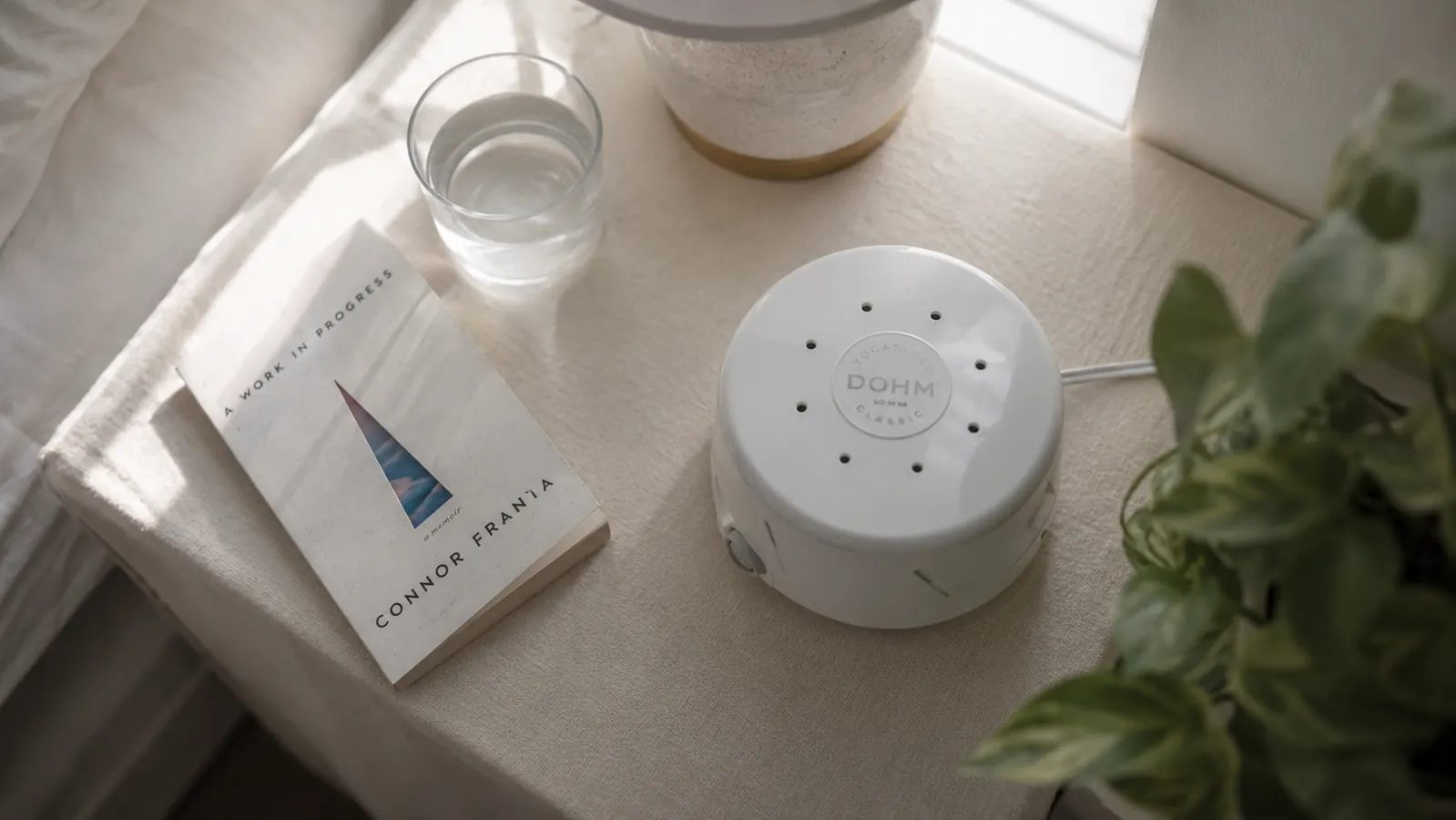
I want to be straight with you before we get into this. The Yogasleep Dohm Classic has a 60-year history, 40,000-plus Amazon ratings averaging 4.6 out of 5, and a reputation that precedes it in almost every sleep forum and bedside conversation I have ever had. All of that is earned. But the five-star reviews tend to gloss over the parts that might actually matter to you before you spend the money, and that is what I am here to cover. My name is Carol. I test sleep accessories so you can make a faster, better decision than I usually do. Here is the honest story on the Dohm, including the things that caught me off guard.
The Yogasleep Dohm Classic is a real-fan white noise machine. Inside the plastic housing, a small motor spins an actual fan, and the sound you hear comes directly from that airflow moving through vents you adjust with two rotating plastic caps. There is no recording, no digital file, no loop. That distinction sounds minor until you have slept with both kinds of machine and you start to understand why it matters. But before I get to the good part, let me tell you what nobody warned me about.
The Quick Verdict
The Dohm Classic is genuinely excellent at one specific thing: producing a natural, loop-free fan sound that your brain stops fighting after a few nights. It earns its reputation. But the volume ceiling is lower than most buyers expect, the tuning range is narrow, and if your problem is a snoring partner rather than ambient room noise or traffic, you may be disappointed. Buy it knowing those limits and you will probably love it.
Amazon Check Today's Price →If ambient noise, traffic, or early alarms are breaking your sleep, the Dohm has been the quiet fix since 1962.
The Yogasleep Dohm Classic uses a real spinning fan, not a recording. Over 40,000 Amazon buyers rate it 4.6 out of 5. Check today's price below.
Amazon Check Today's Price on Amazon →How I Got Here: The Problem the Dohm Actually Solves
I am a light sleeper with an unusually loud neighborhood. Before I started reviewing sleep accessories, I went through the same fumbling progression most people do: foam earplugs, then a cheap digital machine from the drugstore, then a sleep meditation app, then another app that cost money and was not better. Every one of those solutions addressed the symptom without quite solving the problem. Foam earplugs cut sound but made my ears hot. The digital machine had a loop I could not un-notice once I heard it. The apps kept my phone on my nightstand, which kept me checking it at 2 a.m.
I picked up the Dohm specifically because multiple sleep researchers and audiologists I had read referenced it as the closest thing to a clinically neutral sound masker available at a consumer price. That is a mouthful. What it means in plain language: the sound the Dohm produces is continuous, broadband, and non-repetitive, which is what makes it different from a digital file playing on repeat. I went in skeptical. I came out converted, with caveats.
The Honest Truth About the Volume: Lower Than You Think
This is the thing nobody tells you prominently enough. The Dohm Classic is a moderately quiet machine at its loudest. Yogasleep publishes no decibel rating for it, and the third-party measurements I have seen put the maximum somewhere around 75 to 78 dB at about one meter, which is roughly the sound level of a regular conversation. That is enough to cover a ticking clock, a dripping faucet, a creaking house, moderate street noise coming through a closed window, or a partner who gets up early and makes coffee. It is not enough to cover a dedicated snorer.
I want to say this plainly because I have seen the Dohm recommended for snoring partners probably hundreds of times in sleep forums. If the snoring is light to moderate, somewhere in the range where you can still make out individual words if the person were talking, the Dohm can mask it well enough to fall asleep. If the snoring is the kind that makes the walls vibrate, you will want a machine with a higher maximum volume, or you will want a combination of earplugs and a machine together. The Dohm alone will not be enough.
The Dohm is not a volume machine. It is a texture machine. Once you understand that distinction, buying it becomes a much easier decision.
The Two-Cap System: What It Can and Cannot Do
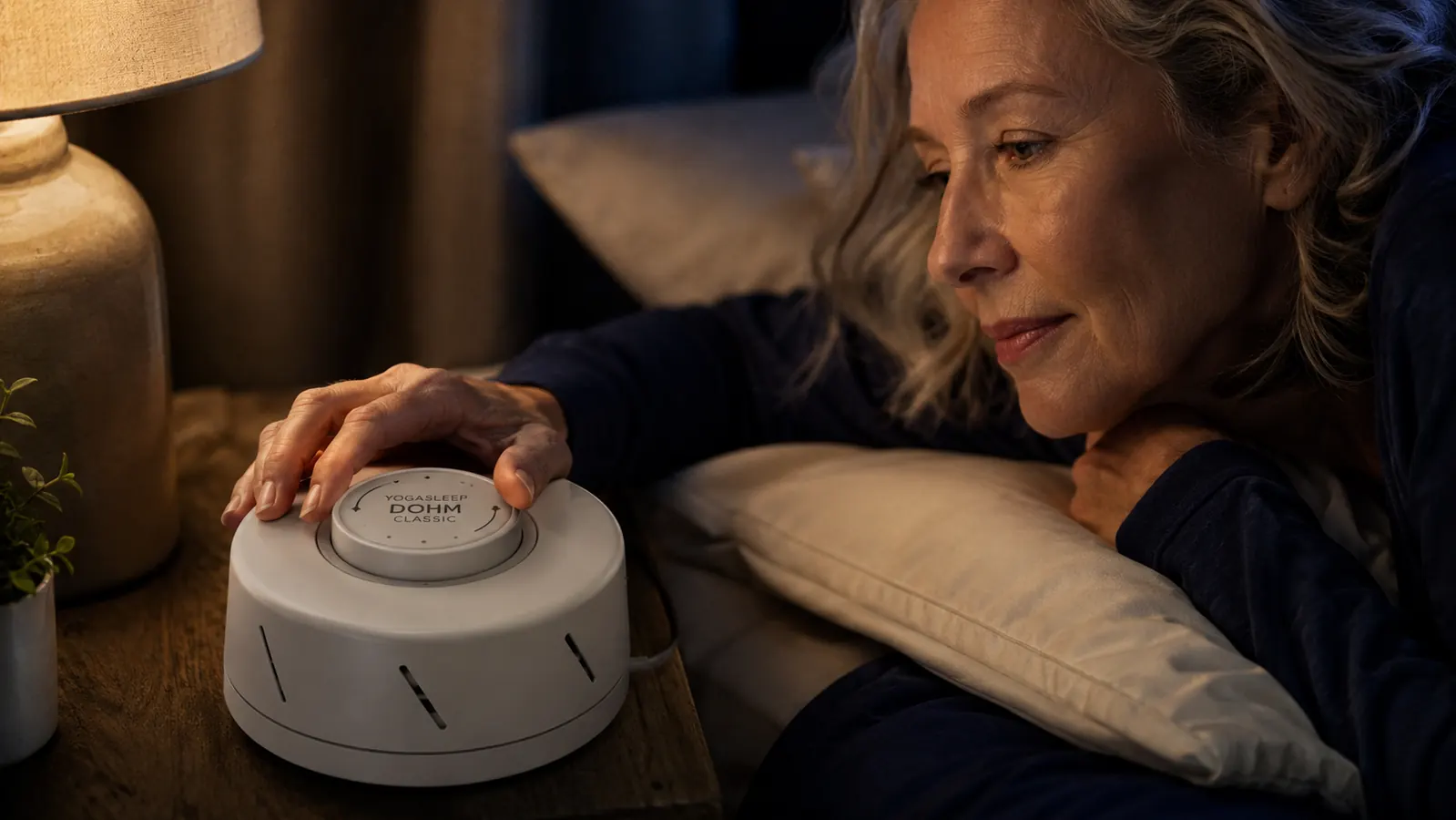
The Dohm Classic has two adjustable plastic caps. The outer ring controls volume by opening or closing the vents cut into the housing. The inner cap on top rotates to shift the pitch and character of the sound, moving it from a lower, rumbly tone to a slightly higher, breezier tone. Between the two controls, you have a range that I would describe as narrow but genuinely useful within that range.
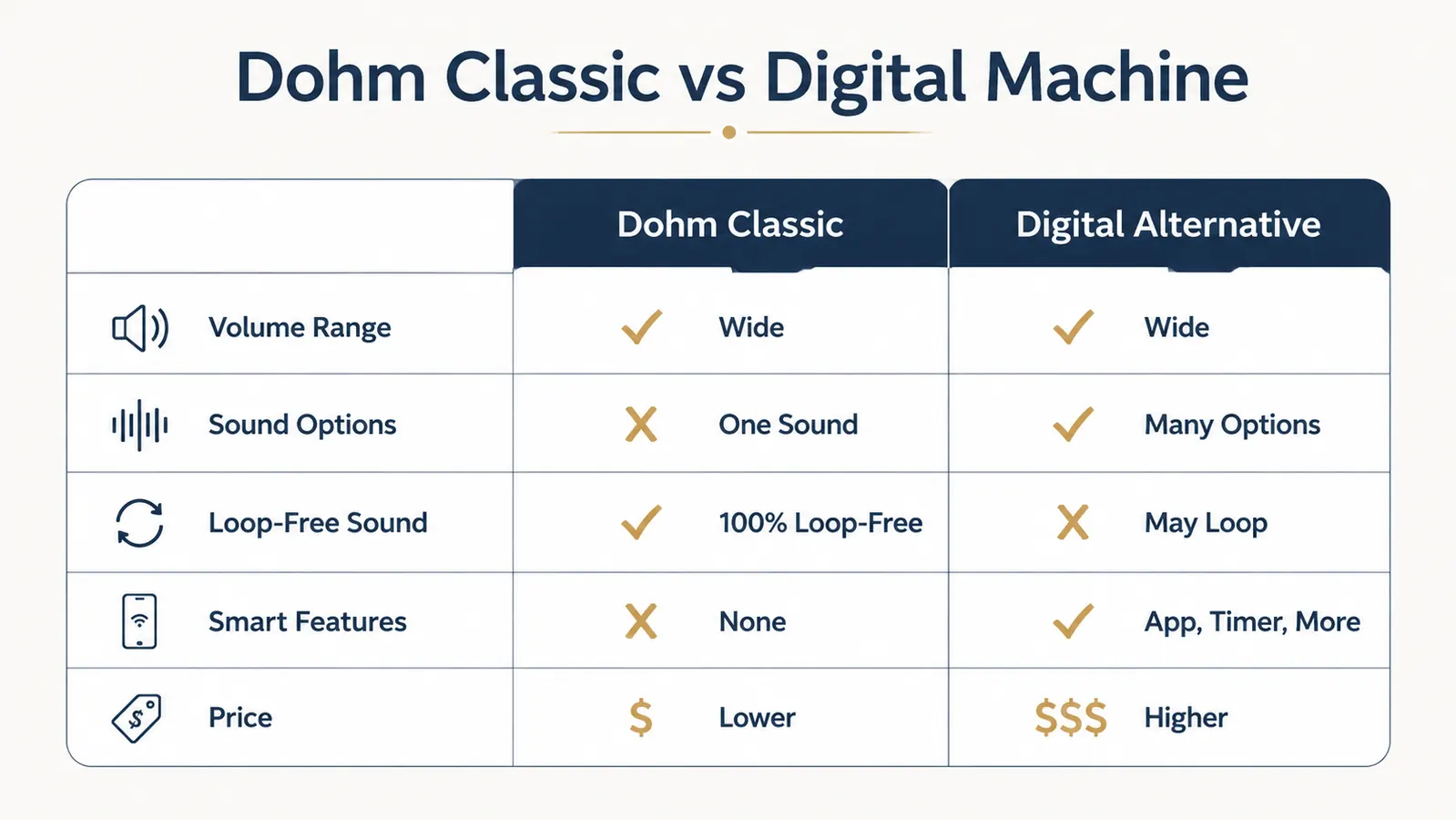
What you cannot do: you cannot get a rain sound, an ocean sound, brown noise, pink noise, or any specific frequency band. You cannot set a timer, a sleep schedule, or a morning fade. You cannot connect to Wi-Fi or pair with an app. If any of those features matter to you, the Dohm is not your machine, and that is a completely legitimate reason to choose something else. What you can do: find a sound setting that feels right for your ears and your room, set it once, and then forget it exists. That simplicity is real and it has genuine value for people who are done fiddling.
One practical note on the caps: they can develop a faint mechanical resistance over time if you rotate them frequently. I noticed this after several weeks of adjusting mine while I was finding my preferred setting. Once I settled on a position and stopped moving them, the resistance went away on its own. The lesson is to spend the first few nights actively experimenting, then commit to a setting rather than adjusting it daily.
What the Loop-Free Sound Actually Does to Your Brain
I said earlier that the Dohm's non-repeating sound is the central reason it works differently from digital machines, and I want to give that idea the space it deserves. When you play a digital sound file, your brain is receiving a pattern even if the loop is long enough that you do not consciously recognize it. The brain is very good at finding patterns, and a pattern, once identified, can become a point of focus rather than a background element. That is one reason some people can listen to digital white noise for a few months and then suddenly find it is not working as well. The novelty wore off and the pattern took over.
The Dohm does not have this problem because the fan never produces exactly the same sound twice. The variation is small but it is real, driven by tiny fluctuations in motor speed, airflow, and the acoustics of the room. Your brain gets a continuous broadband signal with enough natural variation that it never quite locks onto a pattern. For light sleepers whose brains are particularly good at scanning for interesting stimuli even during sleep onset, this difference is meaningful. I noticed it within the first week. My brain seemed to just stop monitoring the Dohm sound the way it monitors everything else in the room.
The Cord and Placement Reality Check
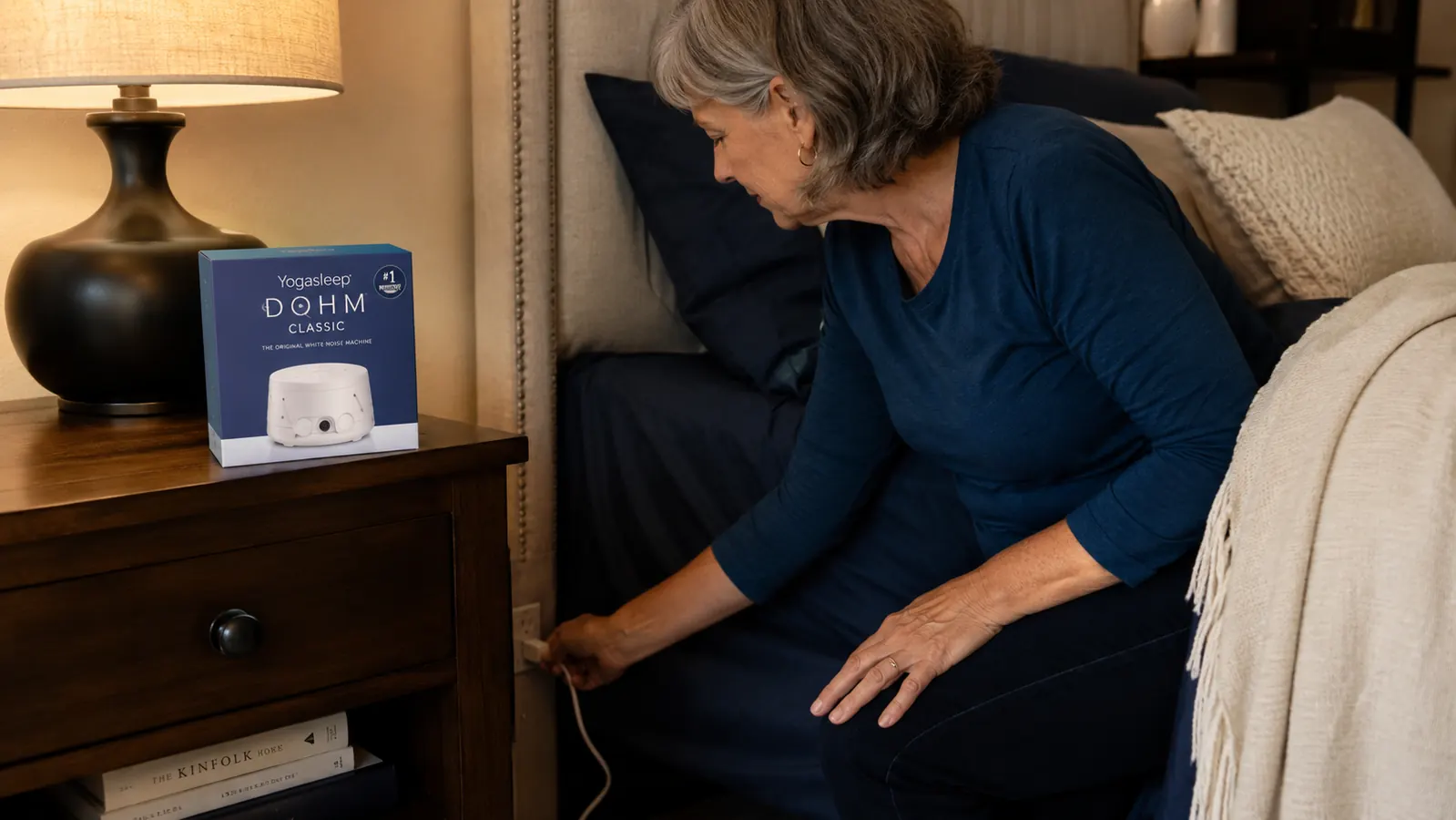
The Dohm Classic comes with a power cord roughly five feet long. That is enough for most nightstand setups if your outlet is on the same wall as your bed. It is not enough if your outlet is on the opposite side of the room, or if your nightstand is at the foot of the bed, or if your bedroom layout requires the machine to be more than about four feet from the nearest wall socket. I mention this because I know people who ordered the Dohm and immediately had to go buy an extension cord, and felt slightly annoyed about that.
The machine also runs on wall power only. There is no battery option, no USB charging input. If you want to use it somewhere without a convenient outlet, you will need either an extension cord or a travel power strip. For most home bedrooms this is not a real obstacle. For travel or for camping or for guest rooms with awkward outlet placement, it is worth planning for. A small travel extension cord weighs almost nothing and solves the problem completely, but it is an extra thing to remember.
Is the Price Reasonable Compared to What Else Is Out There?
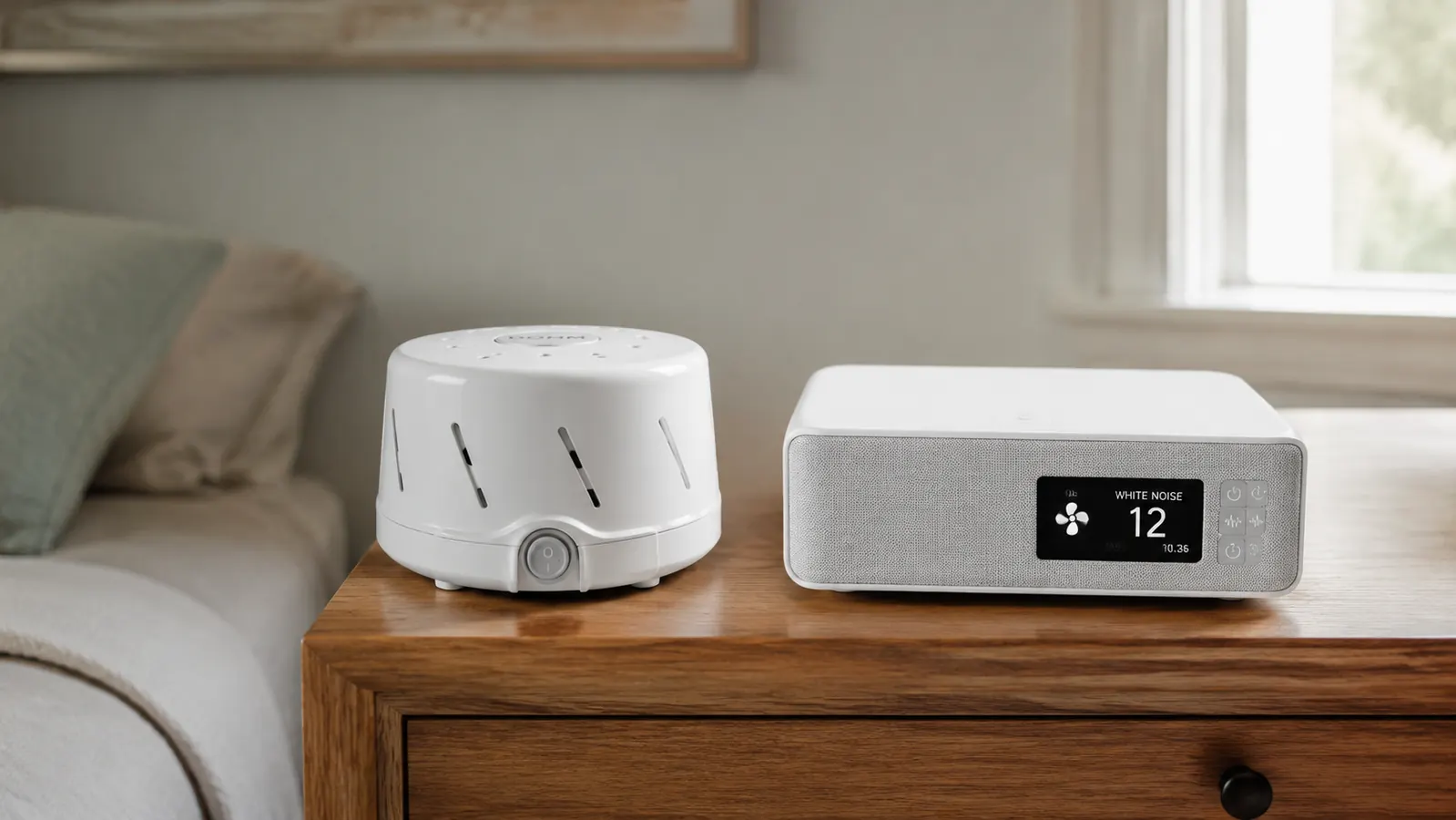
The Dohm Classic carries a current price in the mid-$40 range. That puts it in the middle of the white noise machine market, above the cheapest digital boxes you can find for $20 to $25, and below the premium digital machines that climb past $70 or $80 and offer more sound options, higher volume ceilings, and smart features. Whether the Dohm's price is justified depends entirely on whether the loop-free mechanical sound is worth the premium over a budget digital machine to you.
My honest view: if you have tried a cheap digital machine and it worked fine, the Dohm upgrade is probably unnecessary. If you tried one and something about it felt slightly wrong, a little too crisp, a little too repetitive, or your sleep did not noticeably improve, the Dohm is a meaningful step up and worth the price difference. If you have never tried any machine at all, the Dohm is a reasonable place to start rather than buying cheap first and potentially being disappointed in a different way. For context, you can read the full comparison article on this site that goes side-by-side with the LectroFan, which is the most commonly compared digital alternative.
One thing I will say clearly: the Dohm does not feel cheap in person. The housing is solid, the motor is quiet relative to the sound it produces, and the caps feel substantial. At $44 to $47 you are not getting a toy. You are getting a machine that Yogasleep has been refining for 60 years and that the vast majority of buyers seem to keep. The return rate implied by the 4.6-star average across 40,000-plus reviews is very low. That tells you something.
What I Liked
- Real mechanical fan produces a genuinely non-repeating sound that your brain stops monitoring
- No app, no setup, no Bluetooth pairing required
- Solid build quality with a simple two-cap control that stays put once set
- Compact size fits on a crowded nightstand without taking over
- Lower-frequency sound profile is comfortable over a full 8-hour night
- Over 40,000 Amazon buyers, 4.6-star average, strong track record for reliability
Where It Falls Short
- Maximum volume is insufficient for a loud snoring partner
- No timer, sleep fade, or smart-home compatibility
- Only one sound: mechanical fan. No rain, ocean, pink noise, or other options
- Five-foot cord requires outlet within reach; no battery backup
- Tuning range is narrow, so if the fan sound itself does not suit you, there is no alternative
The First Week: What to Expect
Most people who ultimately love the Dohm went through a slightly strange first few nights. The sound is more present than you might expect at first. It is not harsh, but it fills the room in a way that you notice, and for a night or two your brain might actually feel more alert because something new is happening. This is normal. Do not judge the machine by nights one and two. By night four or five, most people report that they stop consciously registering the sound. By the end of the first week you will know whether it is working for you.
If after a week the sound itself is bothering you rather than fading into background, try moving the machine farther from your head, rotating the tone cap to a lower setting, and closing the volume vents slightly. Some people find the default out-of-box setting too loud and too bright. Dialing it back makes a bigger difference than most buyers realize. I had one neighbor who returned her first Dohm and then bought a second one eight months later after she heard me describe the lower-volume setting, which she had never tried.
Who This Is For
The Dohm Classic is the right call if intermittent household sounds are breaking your sleep: a partner who gets up early, a dog that shifts at 3 a.m., traffic that spikes on weekends, early delivery trucks, or the general acoustic activity of a house that is never fully quiet. It is also a strong choice if you have used digital machines and felt like the sound was slightly off in a way you could not name. The loop-free texture is the likely culprit, and the Dohm fixes it. Finally, it suits people who want nothing to do with apps or screens in the bedroom. You plug it in, you rotate the caps once, and that is the entire user interface.
Who Should Skip It
Skip the Dohm if your main goal is covering a loud snorer. The volume ceiling is real and it will leave you disappointed. Skip it if you want variety in your sounds, brown noise one night and rain the next. Skip it if you want a sleep timer so the machine turns off after you have fallen asleep. And skip it if you want to integrate your bedroom audio into a smart-home setup. None of those things are possible with the Dohm, and choosing a machine that does not match your actual needs is more frustrating than any build quality issue. If that describes you, read the comparison piece on this site covering the Dohm against the LectroFan, where I lay out which use cases each machine actually wins.
There is also a personality fit element here that is hard to quantify. The Dohm rewards patience and simplicity. If you are the kind of person who loves gadgets and wants to optimize settings and try new features, the Dohm will feel underwhelming within a week because there is nothing left to explore. If you are the kind of person who wants to solve a problem and then never think about it again, the Dohm is extremely satisfying. I am in the second group. My machine sits on the nightstand, I flip the switch on, and I go to sleep. That is it.
Tired of tossing around every tiny noise in the house? The Dohm has been the answer for a very long time.
The Yogasleep Dohm Classic is a loop-free, app-free, set-it-and-forget-it sound machine with 40,000-plus Amazon reviews and a 4.6-star average. Check today's price and see if it is right for your bedroom.
Amazon Check Today's Price on Amazon →