
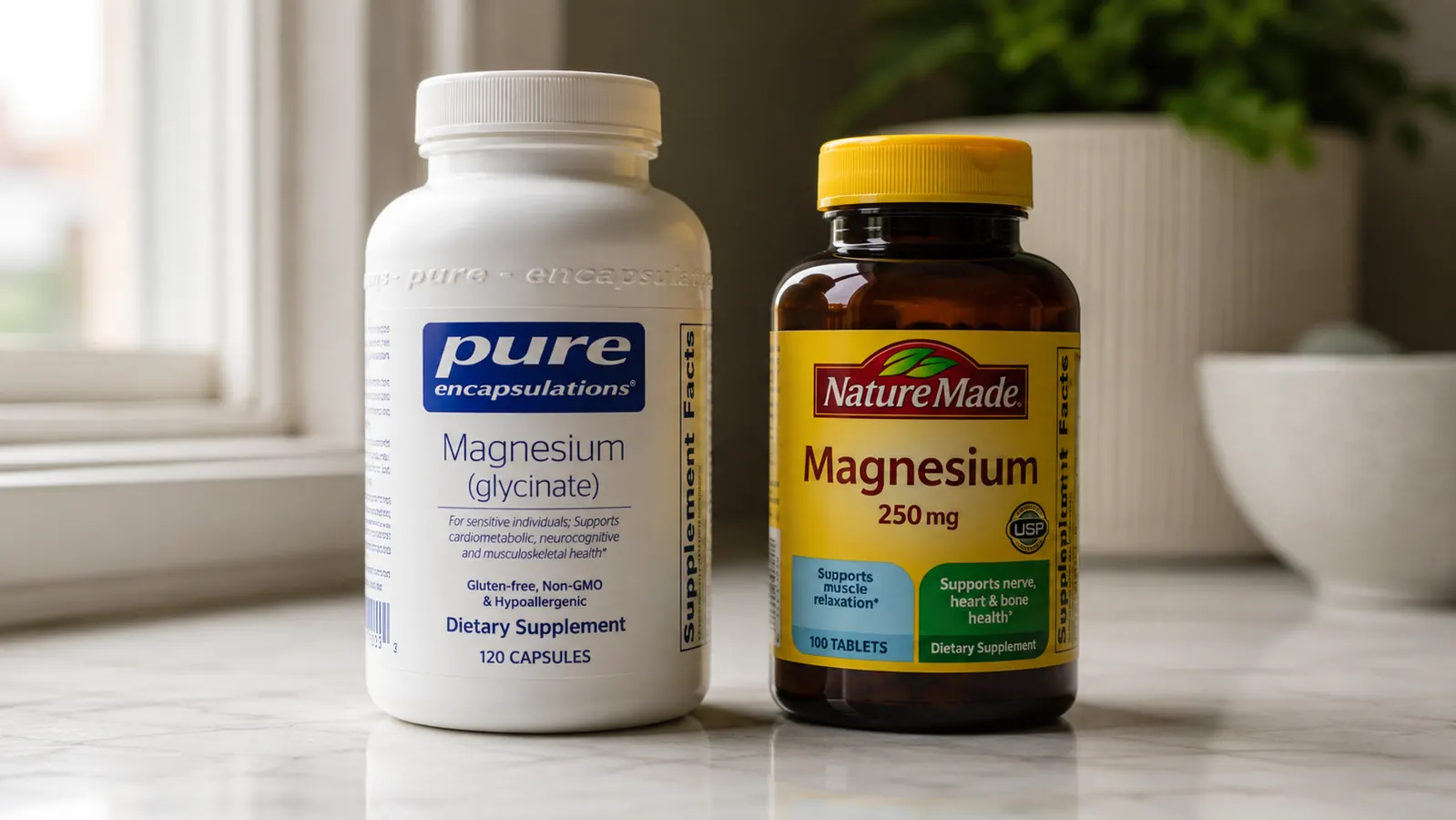
The first time I saw Pure Encapsulations Magnesium Glycinate on Amazon I did what most sensible people do. I looked at the price, looked at the magnesium oxide at CVS for eight dollars, and closed the tab. I am not made of money and I have been burned by overpriced supplements before. Fancy labels do not fix sleep. I told myself that for about six months before I finally stopped being stubborn and bought a bottle. I am writing this because I think the honest answer to the price question is more nuanced than most reviews bother to explain, and you deserve to know what you are actually getting into before you spend close to fifty dollars on a supplement.
Pure Encapsulations Magnesium Glycinate is one of the most-reviewed sleep supplements on Amazon. Nearly 49,000 ratings at 4.7 stars is not an accident and it is also not a guarantee. Crowds can be wrong. So let me tell you what the label actually means, what the real-world difference between this and cheaper magnesium is, and where I think the money is and is not justified.
The Quick Verdict
The premium is real and it is earned, but only if you fall into a specific group. Clean ingredients, proven form, consistent results for people with sensitivities or who have already failed on cheaper magnesium. Not for everyone at this price.
Amazon Check Today's Price →Already tried melatonin and cheap magnesium and still waking up at 3 a.m.? The form of magnesium you take matters more than most people realize.
Pure Encapsulations Magnesium Glycinate uses a chelated glycinate form that absorbs more efficiently and skips the fillers that cheaper supplements rely on. It is the version functional medicine practitioners recommend most often for sleep and relaxation support. Over 48,000 Amazon reviewers have already cast their vote.
Amazon Check Today's Price on Amazon →What Nobody Tells You About Magnesium Forms
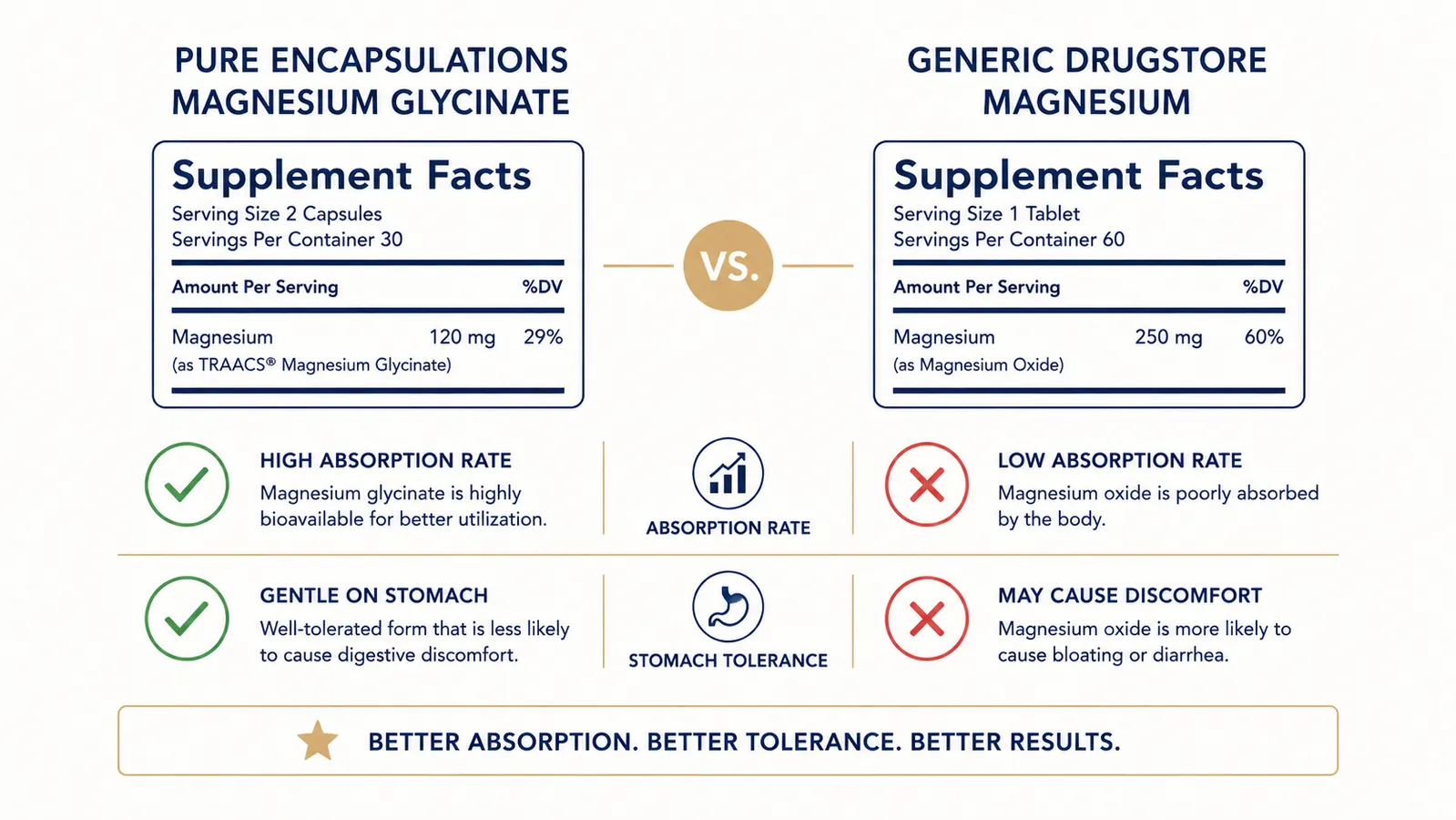
Walk into any drugstore and the magnesium on the shelf is almost certainly magnesium oxide. It is cheap, shelf-stable, and delivers a big number on the label, often 250 mg or 500 mg per tablet. What the label does not tell you is that magnesium oxide has an absorption rate somewhere around four percent. Your body is barely using any of it. The rest ends up in your digestive tract, which is why high-dose magnesium oxide has a reputation for causing loose stools. You are essentially taking a laxative with a sleep supplement side effect.
Magnesium glycinate is different. The magnesium is bound to glycine, an amino acid, in a process called chelation. That bond makes the magnesium easier for your intestinal cells to absorb and much gentler on your digestive system at the same time. Glycine itself has calming properties at the nervous system level, which is one of the reasons this particular form has become the go-to recommendation for people using magnesium specifically for sleep and relaxation. You are not just swapping one mineral for another. You are switching to a form the body can actually use, paired with a co-molecule that compounds the benefit.

What the Label Actually Says (and What It Means)
Each serving is two vegetarian capsules delivering 120 mg of elemental magnesium as magnesium glycinate. That is the only active ingredient. The capsule shell is hydroxypropyl methylcellulose, which is a standard vegetarian capsule material. That is the entire list. No magnesium stearate, no silicon dioxide, no titanium dioxide coating, no artificial colors, no preservatives. Competitors at lower price points often include one or more of those additives as flowing agents or filler. They are generally regarded as safe in small amounts but they are also not nothing, particularly if you have known sensitivities.
The brand is NSF certified, which means an independent third party has verified that the label claim matches what is in the capsule. This matters because the supplement industry in the United States is not required to prove that a label is accurate before putting a product on shelves. NSF certification is one of the few ways you can trust that the 120 mg of elemental magnesium stated on the bottle is what you are actually getting. That is something a seven-dollar store brand cannot promise you.

The Placebo Question: Is It Really Working?
This is the question I kept asking myself, and I want to give it a serious answer rather than brushing it off. Placebo effects are real and significant with sleep supplements in particular. If you spend fifty dollars on something and set a reminder and develop a bedtime ritual around it, you might sleep better simply because you are treating your sleep as worth caring about. I do not think that is nothing. But I also do not think it fully explains what I experienced, and here is why.
Before this product I had tried three other sleep supplements at various price points over the prior year, including a fifty-dollar bottle of a branded ashwagandha complex that did absolutely nothing I could detect. Spending money on a bottle had not automatically improved my sleep with those products. The magnesium glycinate was different in a specific, repeatable way: the frequency of lying awake with physical tension, that wired-but-tired feeling where your mind has already quieted but your body has not, decreased noticeably over time. That particular symptom pattern is consistent with what magnesium does physiologically. Magnesium is involved in regulating the GABA receptors that dial down nerve cell excitability. It is not a mystery mechanism. My experience tracked with what the molecule actually does.
Spending fifty dollars had not automatically helped me sleep with other supplements. The magnesium glycinate was different in a specific, repeatable way. That matters when you are trying to figure out whether something is actually working.
The Three Things That Surprised Me
First, the onset timeline. I had read other reviews before buying and most of them said something like the first week did not do much. That is accurate. I almost stopped after week two. The change came gradually enough that I almost missed it. If I had not been paying attention I would have written this off. That slow onset is probably the biggest reason this supplement gets returned or abandoned, not because it does not work, but because people are expecting something that works the way melatonin works, which is more or less immediately. This is not that kind of supplement.
Second, no morning grogginess. I was prepared for that based on other supplements I had tried. Melatonin at even moderate doses often left me feeling thick-headed until mid-morning, like I had slept too long even when I had not. Magnesium glycinate has no sedating hangover. You wake up the same as you normally would. The sleep improvement, when it comes, is about quality rather than about being sedated into unconsciousness.
Third, the capsule size. I expected larger pills given that this is a supplement brand and not a pharmaceutical, and the capsules are actually quite manageable. Standard size-zero vegetarian capsules. Anyone who can swallow a standard vitamin can handle these. I mention this because a couple of online reviews flagged it as a concern and I found it to be a non-issue.
Where the Price Argument Gets Honest
A 90-capsule bottle at today's price gives you 45 nights of two-capsule servings. Per night that is slightly more than a dollar. Compared to what people spend on melatonin gummies, over-the-counter sleep aids, or a single night of poor sleep followed by a foggy workday, that math holds up. What I am less willing to do is pretend that the price difference between this and a reputable chelated magnesium at a lower price point is always justified.
If you have no food sensitivities and you are not particularly worried about filler ingredients, a well-reviewed magnesium glycinate from a brand like Doctor's Best, which uses a similar chelated form and costs roughly half as much per capsule, is a legitimate alternative. The Pure Encapsulations premium is earned by the allergy-friendly manufacturing, the NSF certification, and the purity standard. If those specifics matter to your situation, the price makes sense. If they do not, you are not throwing money away by starting with a less expensive glycinate product to see if the form works for you before upgrading. See how these options compare in the magnesium glycinate capsules versus Natural Calm powder breakdown for more context on the full category.
What the 48,000 Reviews Are Actually Telling You
I went through a sizable chunk of the negative reviews before writing this. The pattern is instructive. The one-star and two-star reviews break down into roughly three buckets: people who expected it to work fast and stopped too soon, people who had a shipping or packaging complaint rather than a product complaint, and a small number of people for whom it genuinely did not help. What I almost never saw was a complaint that the product caused side effects, that the capsules were inconsistent, or that the purity was questionable. The negative reviews for most supplements tend to include a meaningful cluster of people reporting nausea, headaches, or other reactions. That cluster is essentially absent here. That absence is meaningful.
The five-star reviews lean heavily on two consistent themes: people who had already tried cheaper magnesium without results and then switched to this form, and people with autoimmune conditions, food sensitivities, or medically supervised supplement protocols who needed the allergen-free formulation. Both of those groups make sense given what we know about the product. The high rating is not an anomaly and it is not inflated by a single wave of early promotional reviews. The volume is too large and too spread over time for that.

The Real Cons Worth Knowing Before You Buy
The 120 mg elemental magnesium per serving is on the conservative end. Some practitioners recommend 200 to 400 mg of elemental magnesium for sleep support in adults who are genuinely deficient. Getting to 300 mg from this product means taking five capsules per night, which turns one bottle into an 18-day supply instead of a 45-day supply. If you end up needing a higher dose, the cost per month climbs fast. That is not a product quality problem but it is a practical consideration the label does not make obvious.
The other real con is that this supplement is not going to fix sleep problems that have a different root cause. If you are sleeping poorly because your bedroom is too warm, because you are scrolling your phone until midnight, or because a life stressor is keeping your cortisol elevated, magnesium glycinate is not going to override that. It works best when the underlying issue is insufficient dietary magnesium leading to elevated muscle tension and an overactive nervous system at night. It is one tool, not a complete solution. For a deeper look at how I actually incorporated it into a full nighttime routine, the personal story behind switching from melatonin to magnesium covers the context that numbers alone do not.
What I Liked
- Chelated glycinate form absorbs efficiently and is far gentler on the stomach than oxide or citrate forms at equivalent doses
- NSF certified: independent third-party verification that the label matches what is in the capsule
- Completely free of common allergens, artificial coatings, and flowing agents, the cleanest ingredient panel in its category
- No morning grogginess, works differently from sedating supplements, waking experience is normal
- Nearly 49,000 Amazon ratings at 4.7 stars with almost no pattern of adverse reactions in negative reviews
- Glycine co-molecule adds its own calming effect on nerve cell excitability, compounds the sleep benefit
Where It Falls Short
- Premium price is a real barrier, roughly four times the cost of drugstore magnesium oxide per bottle
- Conservative 120 mg elemental dose means higher-need users will burn through a bottle quickly
- Slow onset, expect three to five weeks before noticing meaningful changes, easy to abandon too soon
- Will not help sleep problems driven by lifestyle factors, screen exposure, or cortisol issues
- No direct equivalent of the low-cost option for people who just want to try the glycinate form without the premium brand
Who This Is For
This product is worth the price if you fit one or more of these descriptions: you have tried a cheaper magnesium supplement and it either upset your stomach or did nothing; you have known sensitivities to gluten, soy, dairy, or common supplement fillers; your sleep problem presents as physical tension and difficulty staying asleep rather than difficulty falling asleep in the first place; or you are already under medical supervision for a supplement protocol and your provider has suggested the Pure Encapsulations brand specifically. For that group, the purity certification and the formulation quality are not just marketing. They are the reason this product works where others have not. The long-term daily use review goes deeper on the month-by-month experience if you want more detail before deciding.
Who Should Skip It
If you have never tried any form of magnesium supplement before, starting with this brand is like buying a professional chef's knife to learn to cook. You might love it, but a less expensive version of the same tool would serve just as well while you figure out whether the category works for you at all. Start with a reputable magnesium glycinate at a lower price, confirm that the form agrees with your digestion and that you notice any effect after four to six weeks, and then upgrade to Pure Encapsulations if you decide you want the added purity assurance for the long term. Also skip this if you have kidney disease or chronic kidney impairment, since impaired kidneys cannot regulate magnesium excretion normally and supplementation without medical guidance carries real risk. And if your sleep problem is primarily about falling asleep rather than staying asleep, or if a racing mind rather than physical tension is the culprit, this supplement is unlikely to be your answer.
If cheaper magnesium has already let you down, the form is probably the problem. Glycinate is the fix most people needed from the start.
Pure Encapsulations Magnesium Glycinate is the version functional medicine practitioners reach for first because the absorption is reliable and the formula has no hidden variables. Nearly 49,000 reviews at 4.7 stars says the people who stuck with it are glad they did. Check today's price and see if the bottle size makes the math work for you.
Amazon Check Today's Price on Amazon →