
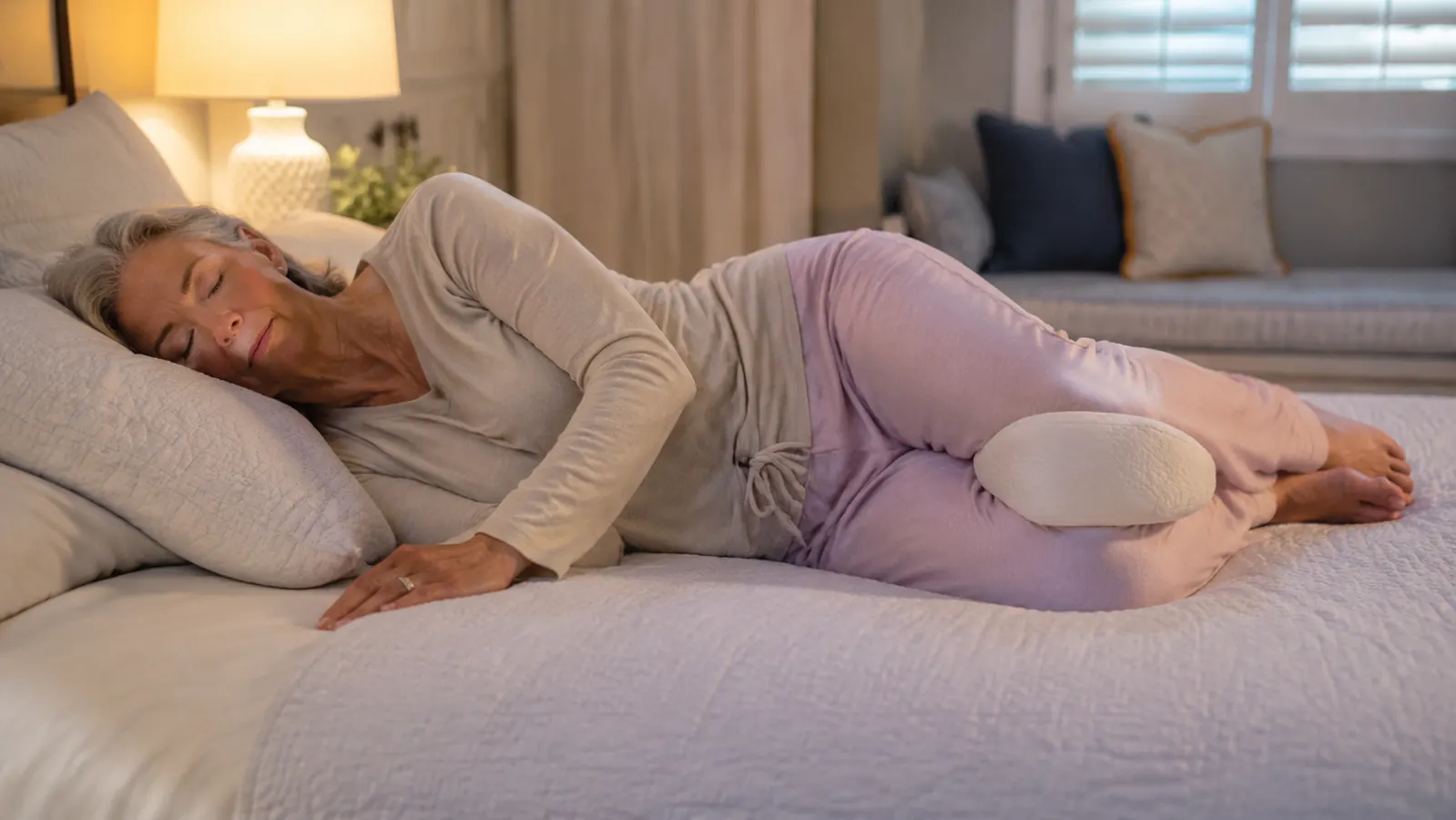
You go to bed feeling fine and wake up at 2 a.m. with a hip that aches like someone parked a car on it. If that sounds familiar, you are in good company. Hip pain that shows up at night, especially on the side you sleep on, is one of the most common complaints I hear from other side sleepers in their 50s. The frustrating part is that you are not doing anything wrong. The problem is what happens to your skeleton when your top leg drops forward without support.
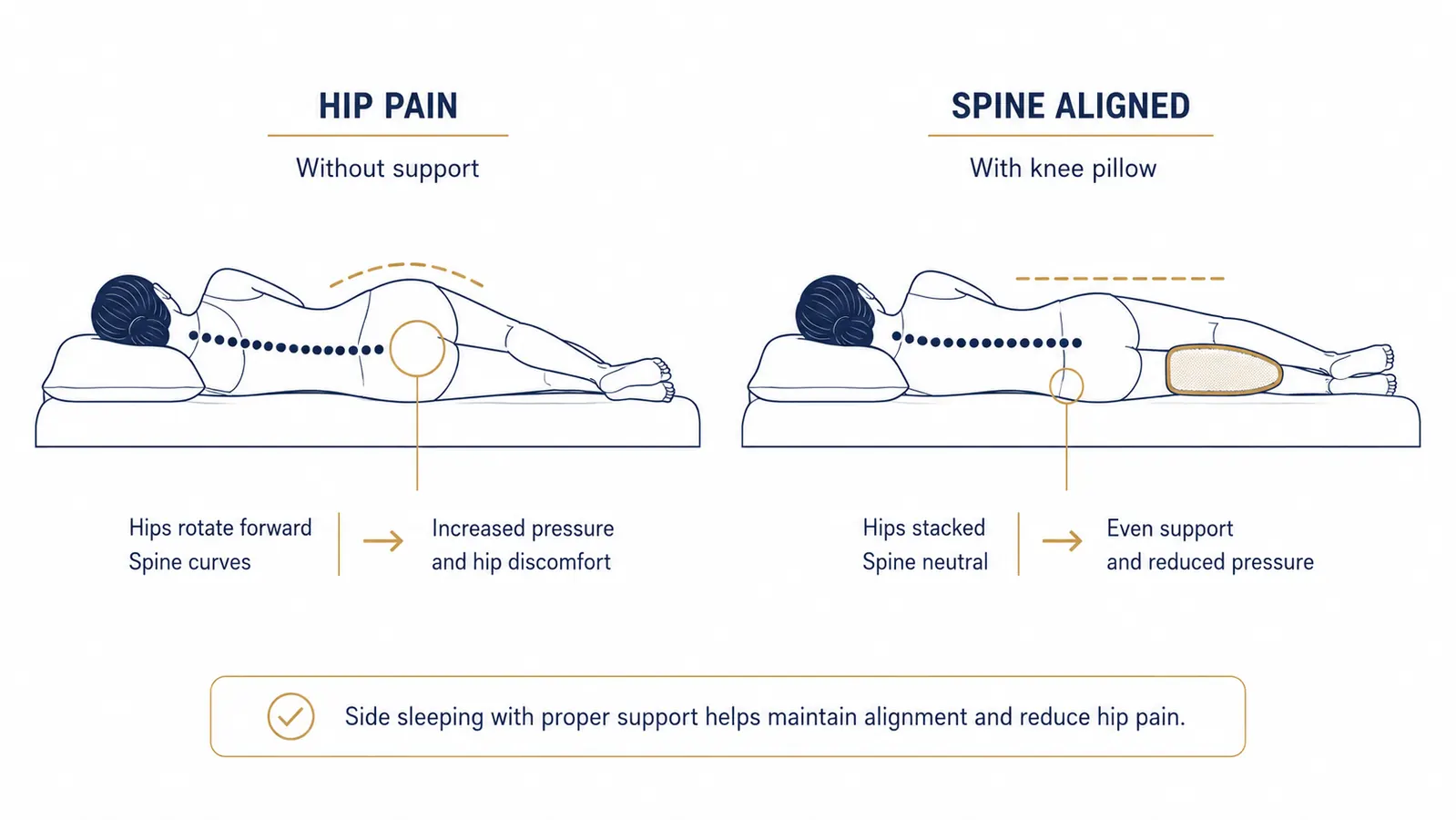
When you sleep on your side and your top knee falls toward the mattress, your hip rotates inward, your pelvis tilts, and your lower spine curves sideways to compensate. Hold that position for six or seven hours and your hip joint, the bursa sac around it, and the muscles along your IT band are all under sustained, low-grade strain. A knee support pillow solves this by keeping your hips stacked and your spine as close to neutral as it would be if you were standing upright. I have been using the Contour Legacy Leg and Knee Foam Support Pillow for just over four months and the step-by-step method below is what actually worked for me after a lot of trial and error.
Stop waking up with a sore hip: the pillow side sleepers keep buying
The Contour Legacy has 42,000-plus Amazon reviews and a contoured shape that holds your knees apart without you having to reposition it at 3 a.m. It is the tool I recommend throughout this guide.
Amazon Check Today's Price on Amazon →Step 1: Start With Your Mattress Firmness Before Blaming Your Joints
Before you place a single pillow, spend two minutes assessing your mattress. If your hip sinks more than an inch or two into the surface when you lie on your side, the mattress itself is contributing to the problem. A too-soft mattress lets your bottom hip drop below your spine's midline, which creates the same rotation problem you are trying to fix. You do not necessarily need a new mattress right now, but if you have one that is more than eight years old or visibly sagged in the center, the pillow will help less than it should.
A quick test: lie on your side and have someone take a photo of you from behind. Your spine should look roughly straight from neck to tailbone. If your waist dips dramatically toward the mattress, you are dealing with a support problem underneath, not just a knee-spacing problem. For most people reading this, the mattress is acceptable and the knee-pillow approach will cover the remaining gap.
Step 2: Choose the Right Pillow for Your Specific Sleep Position
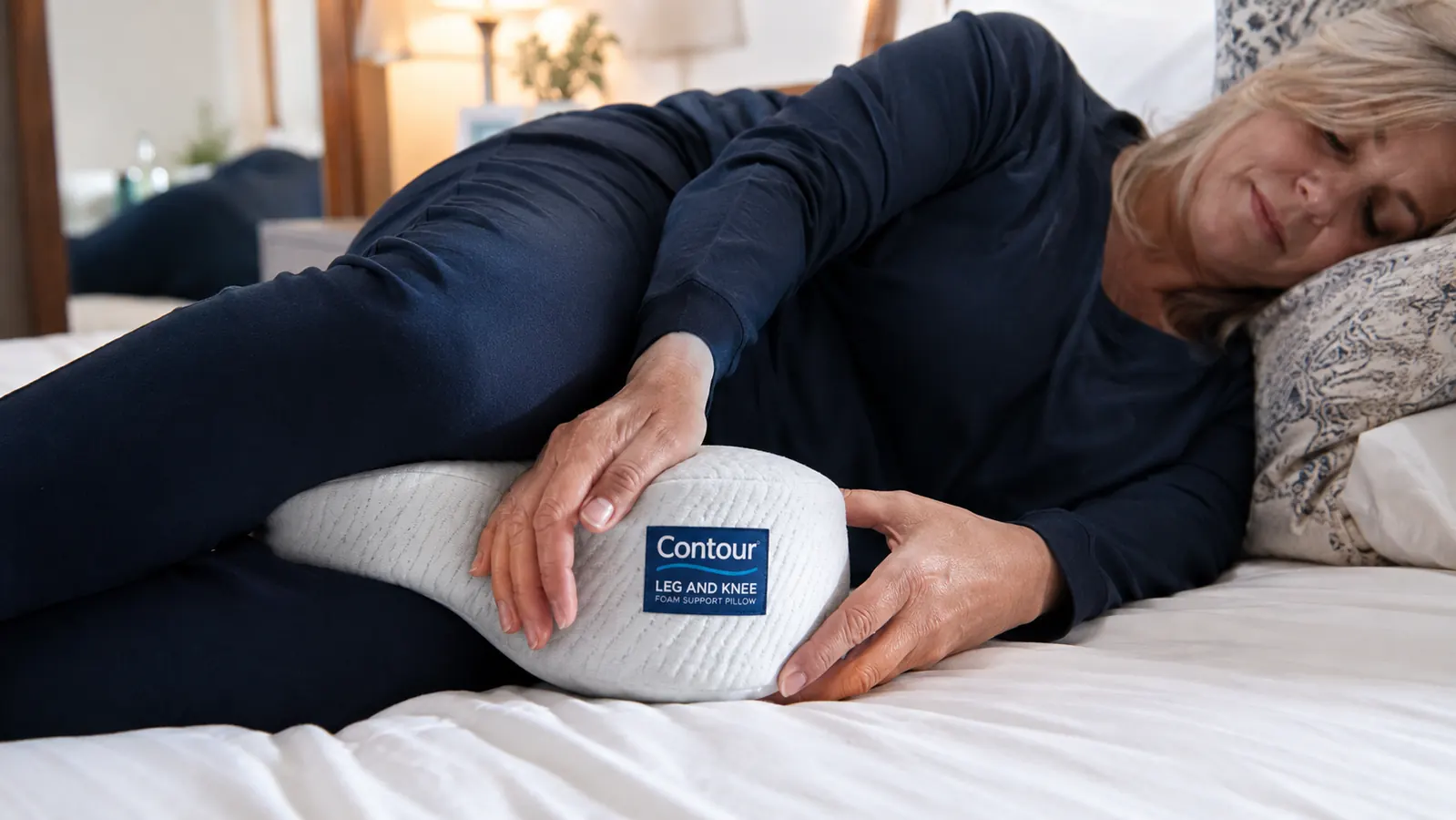
Not all knee pillows work the same way, and the shape matters more than most people expect. There are three main types. A flat rectangular pillow is the cheapest option, but it tends to slide out from between your knees overnight, especially if you are a restless sleeper. A contoured hourglass pillow, like the Contour Legacy, has cutouts on either side that cradle each knee and hold the pillow in place passively. A wedge pillow is thicker, angled, and works better for people with knee pain who need more elevation rather than just lateral spacing.
For hip pain specifically, I recommend a contoured foam pillow in the 6-to-8-inch height range. That thickness is enough to keep your top hip level with your bottom hip without overcorrecting and pushing your top hip too high, which creates a different kind of strain. The Contour Legacy is 6.75 inches at its tallest point, which hits the right range for most people between 5'4" and 5'10". If you are significantly taller or shorter, you may need to experiment with pillow height. A comparison of how shape affects your sleep position is worth reading if you are still deciding, and I have a detailed breakdown in the Contour Legacy vs knee wedge pillow comparison.
Step 3: Position the Pillow Before You Lie Down, Not After
This sounds obvious but almost everyone gets it wrong the first few nights. Most people lie down, realize they forgot the pillow, and then try to wedge it in after the fact. When you do it that way, you end up placing the pillow at whatever angle your knees happen to be in at that moment, which is often slightly too low (against the lower shin rather than between the knees), slightly off-center, or at an angle that puts pressure on the inside of your kneecap instead of cushioning the joint.
The right approach: sit on the edge of the bed, hold the pillow against your knees, then rotate onto your side while keeping the pillow in place. Once on your side, do a quick check. The thickest part of the pillow should sit between your knees, not your thighs and not your ankles. Your top knee should feel like it is resting, not tilting upward and not pushing downward. If you use the Contour Legacy, the two curved channels should cradle one knee on each side. If the pillow feels like it might slide, use the optional leg strap that comes with the pillow to secure it loosely around your thigh.
I know the strap sounds fussy. I resisted it for the first three weeks. But if you wake up at 4 a.m. and the pillow has migrated to the foot of the bed, you will start using the strap. It is not tight and it does not cut off circulation. It is more of a loose reminder to your body not to kick the pillow away.

Step 4: Adjust Your Top Hip Into a Stacked Position
With the pillow in place, your job is to get your hips stacked one directly above the other rather than one tilted forward over the other. Bend both knees to somewhere between 30 and 45 degrees. A full 90-degree fetal position puts more torque on the hip than a relaxed partial bend. If you naturally curl up tightly, try pulling your knees slightly back, closer to a straight leg, until you feel the hip pressure ease.
Your bottom arm should extend forward or rest under a low, flat pillow rather than being tucked under your head. When your head and neck pillow is too thick it tips your spine out of neutral just as surely as an unsupported knee does. For most side sleepers, a pillow with a loft of four to five inches is appropriate. If you are a petite person or a man with narrow shoulders, go lower.
The night I finally got the position right, I slept five hours straight without waking up once. I had not done that in two years. It was not magic. It was geometry.

Step 5: Give Your Body Three Weeks to Adapt
Here is where most people give up too early. The first two or three nights with a knee pillow often feel awkward. You are not used to the thickness between your legs, your muscles have been holding a compensatory pattern for months or years, and your brain keeps waking you up because something feels different. This is normal. It is not a sign that the pillow is wrong.
What I found helpful in the first week was to also do a short hip-flexor stretch before bed. Lie on your back, pull one knee to your chest, hold for 30 seconds, switch sides. That loosens the hip flexors that have been tightening under the strain of poor sleep positioning. Combine that with the pillow and most people start noticing real improvement by the end of the second week. By week three, sleeping without the pillow starts to feel wrong, which tells you the alignment is becoming your new default.
If you are still waking with hip pain after three full weeks of consistent use, that is worth a conversation with your doctor. True hip bursitis, hip labral tears, or referred pain from a lumbar disc do not resolve from repositioning alone. A knee pillow is a posture tool, not a medical treatment. But for the majority of side sleepers whose hip pain is positional, the three-week window is genuinely long enough to see the difference.
What Else Helps Alongside the Knee Pillow
The knee pillow does the heaviest lifting, but a few other changes accelerate the results. First, keep your bedroom cool. Hip pain that wakes you up is sometimes compounded by heat, which causes restless shifting and unconscious position changes throughout the night. A room at 65 to 67 degrees Fahrenheit reduces how often you move around, which means you stay in the correct position longer.
Second, if you share a bed with someone who moves a lot, a mattress with good motion isolation will help. Every time your partner's movement rocks the mattress, your body makes small positional adjustments in response, and some of those adjustments pull your hip out of alignment. You do not need a new mattress necessarily, but it is worth knowing that this is happening.
Third, consider the side you default to. Many people have one side they sleep on more than the other. If one hip is consistently more sore, that is almost always the bottom hip taking repeated pressure. Gradually training yourself to alternate sides, even if it takes a few weeks, distributes the load more evenly. The knee pillow helps on both sides, so the position work you have already done transfers over.
I have written up a full review of the Contour Legacy with specific notes on how it performs across different sleeping positions, which you can find at the long-term Contour Legacy review. And if you want a quick summary of all the ways a knee pillow changes your sleep posture, the 10 reasons a knee support pillow helps side sleepers article covers the physiology clearly.
Four months of nightly use and I still reach for it before bed every night
The Contour Legacy Leg and Knee Foam Support Pillow is the most consistent sleep-posture change I have made in years. Over 42,000 Amazon shoppers agree it earns its spot on the nightstand.
Amazon Check Today's Price on Amazon →